Model Router
The best model for every task.
No AI model is best at everything. One writes the best plan, another writes the best code, a third checks the work. The Model Router reads each task as it starts, gives it to the model that does it best at the lowest price, checks what comes back, and hands the result to the next model with its context intact. That choice is Maestro’s. Maestro is the model at the heart of ZB Stack. It knows every model, and the cloud each one runs on.
- GPT drafts, plans
- DeepSeek code
- Qwen extraction
- Fable specs
- Gemini images
- GLM translation
- Astra hard planning
- Llama cleanup
- Sonnet tests
- Opus review
- Mistral tagging
- Grok research
95%less with Maestromodel usage plus 5%
By kind of work
- Specs$2.16
- Planning$0.36
- Code$2.10
- Extraction$0.03
- Images$0.30
- Copy$0.36
- Translation$0.19
- Tagging$0.0055
- Summaries$0.16
- Research$0.16
- Cleanup$0.03
- Tests$1.47
- Review$1.92
Northwick Candle Co., the example build. Every result is checked before it ships.
300+ AI model endpoints across 14 leading model providers.
What makes it different
A router asks where to send a request. Maestro asks the best way to get the job done.
Most routers send one request to one model and stop there. Maestro looks at the whole job. Which model for each task. Which cloud. Whether the result passed. What to do when it did not. Then it learns from the answer, so the next job goes better.
How one run works
Six steps, the right model for each.
Every run your AI team starts goes through the same six steps. Plain code runs them, checks the work and keeps the budget, with no model needed for that part. Each step goes to the model that suits it: the top model plans and signs off, low-cost models do the bulk of the work side by side, and a mid-price model takes the harder fixes and reviews each one. Only passing attempts are billed.
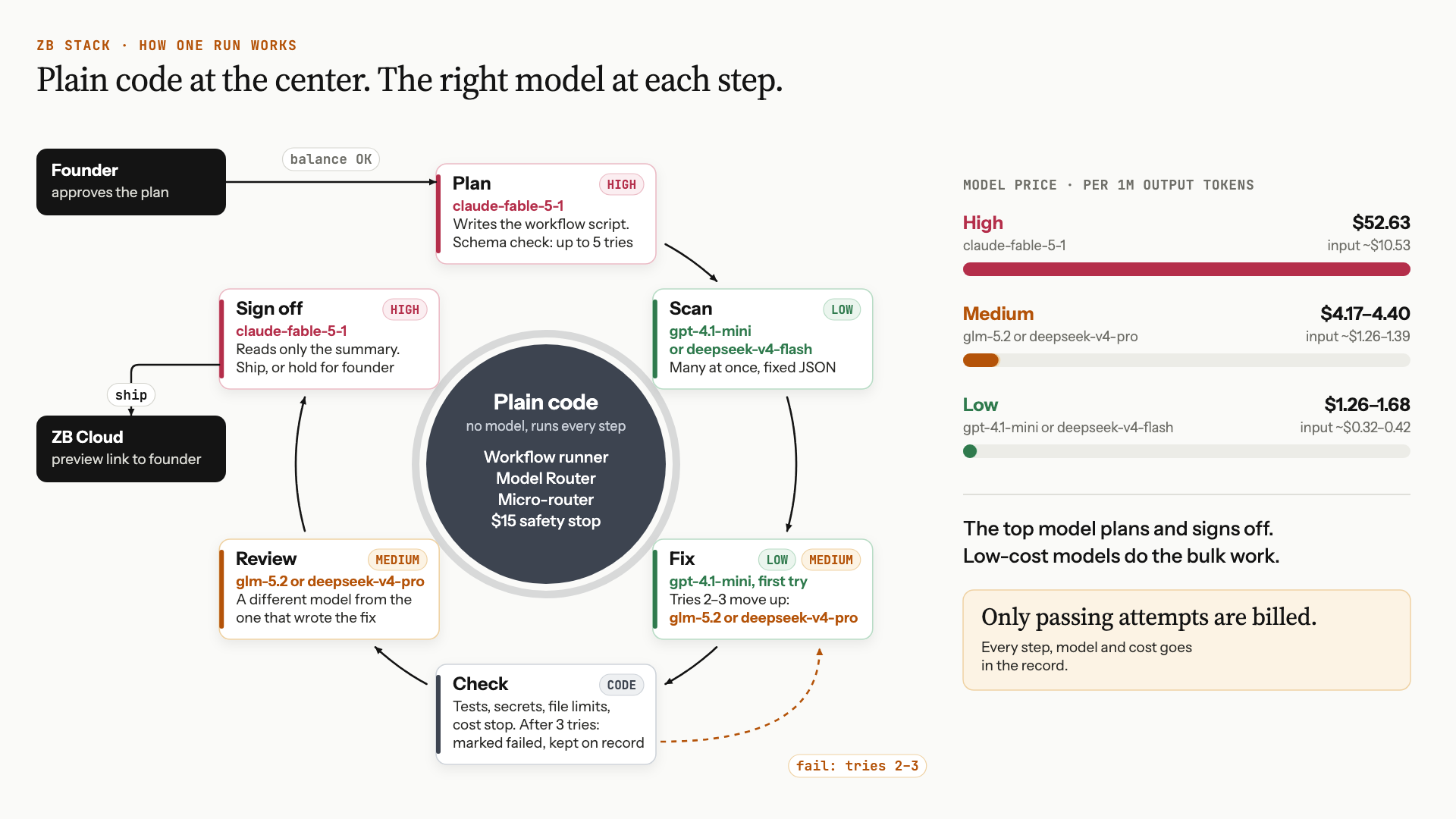
- Step 1 · High
Plan the run.
The top model, claude-fable-5-1, writes the workflow script for the whole run: what to scan, what to fix, and which checks each fix must pass. Plain code checks the script’s shape and asks for a new one when needed, up to five tries.
- Step 2 · Low
Scan, many at once.
Low-cost models, gpt-4.1-mini or deepseek-v4-flash, read the work side by side. Each one returns its findings in the same fixed JSON shape, so the next step can act on them directly.
- Step 3 · Low, then Medium
Fix, one copy per fix.
gpt-4.1-mini writes the first try at each fix, in its own isolated copy of the code. Tries two and three move up to glm-5.2 or deepseek-v4-pro. The higher price applies to that one fix, not the whole run.
- Step 4 · Plain code
Check every fix.
Plain code runs the tests and checks for secrets, file limits and cost. A fix that passes moves on to review. After three tries, a fix is marked failed and kept in the record.
- Step 5 · Medium
Review with a second model.
glm-5.2 or deepseek-v4-pro reads each passing fix. The reviewer is always a different model from the one that wrote the fix. Approved fixes are merged.
- Step 6 · High
Sign off and ship.
claude-fable-5-1 reads a short summary: what passed, what failed, and the cost at each price tier. The run ships to ZB Cloud and the founder gets a preview link. Every step, model and cost goes in the record.
Example
One task, followed through the Router.
An abandoned-cart email for Northwick Candle Co., our example store, which sells in two currencies. Each step shows its model and its cost. One test fails. Only the fix moves to a stronger model.
| Step | Model | Why this model | Cost |
|---|---|---|---|
| Write the task spec | Fable | Best at specs | $0.22 |
| Plan the files | GPT | Drafting and planning | $0.03 |
| Write the code, four files | DeepSeek | Strong code at a low price | $0.04 |
| Write the tests | Sonnet | Testing | $0.05 |
| One test failed. Re-routed to the next model up. | Opus | Stronger model for the fix | $0.08 |
| Review the change | Opus | Review by a model that did not write the code | $0.07 |
| Write the email copy and subject lines | GPT | Copy | $0.01 |
| Merge and deploy a preview | ZB Cloud | Hosting | $0.00 |
| Total | $0.52 |
The same task with everything on one model: $1.45. List prices on 10 October 2026. The deploy step is part of hosting, charged separately; the 5% fee is separate too.
At scale
The same build. Three prices.
Northwick Candle Co. is our example store: a storefront, an AI shopping assistant and the eighteen systems behind them. 3,559 AI tasks across 12 models.
Seventy-nine tasks failed a check and were re-routed; their retries are inside the $29.10. Example build, not a customer result.
The board
Twelve models on the board today.
The board is the set of models the Router uses most for each kind of work. It changes when a better model ships or a price moves; your AI team gets the change on the next task.
| Kind of work | Model today |
|---|---|
| Specs | Fable |
| Drafting, planning | GPT |
| Hard planning | Astra |
| Code, summaries | DeepSeek |
| Testing | Sonnet |
| Review | Opus |
| Research | Grok |
| Images | Gemini |
| Translation | GLM |
| Extraction | Qwen |
| Cleanup | Llama |
| Tagging | Mistral |
Behind the board: 300+ AI model endpoints across 14 leading model providers. From OpenAI, Anthropic, Google, xAI, DeepSeek, Qwen, GLM, Kimi, MiniMax, Mistral, NVIDIA, Cohere, Perplexity and more.
Key ideas
Built on five ideas.
Everything the Model Router does comes from five simple pieces.
- Task
- One piece of work with one result: a spec, a file of code, an image, a reply to a customer.
- Rule
- Where a task may go and how much it may spend. Set once, applied to every task it covers.
- Route
- The Router’s choice of model for a task, made as the task starts.
- Check
- A test, a review or a rule that the result must pass, run by something that did not produce it.
- Record
- Every task with its model, the reason, the check and the cost.
For developers
Rules, written as a short list.
Developers can set rules for a product or a whole workspace. Route work by cost, speed, quality and your own rules. You can pin a model on any task.
# Example. A routing rule for one product.
rule: northwick-store
prefer: sponsored            # use sponsored models when they do the task well
data_location: [us, ca]      # providers that keep data in the US or Canada
check:
  code: tests + review       # tests must pass, a second model reviews
  copy: review
on_fail: next_model_up       # re-route only the failed task
max_cost_per_task: auto      # set by the balance
pin:
  images: gemini             # always use this model for images
Model Router
Every task, on the best model for it.
Tell us what you want to build. Sponsored models are free.
Apply for access